

Many e-commerce business owners use Magento for their online stores as it provides advanced catalog controls, custom checkout logic, complex integrations, and support for large product ranges. The platform can be customized, although you’d need help from top Magento development companies.
The right development company can help implement necessary adjustments fast plus provide future customizations and maintenance. So, check out our post on how to choose a Magento development company that will fit your business goals, budget, and preferences.
Key points
- 8 Top Magento Development Companies
- How We Ranked Magento Development Companies
- How to Choose the Right Magento Development Companies – Expert Advice
- Define Your Project Scope and Business Goals
- Evaluate Technical Stack and Engineering Talent
- Check Communication Processes and Time Zone Fit
- Consider Scalability and Long-Term Partnership Potential
8 Top Magento Development Companies
These companies have top professionals experienced in using Magento platform:
- Atwix.
- Rave Digital.
- Elogic Commerce.
- Brainvire Infotech.
- Soloway.tech.
- Red Jumpers.
- Ziffity Solutions.
- Staylime.
Check each company’s strong sides and especially whether your schedules align. Time zones are important if you prefer meetings with the developing team.
Atwix
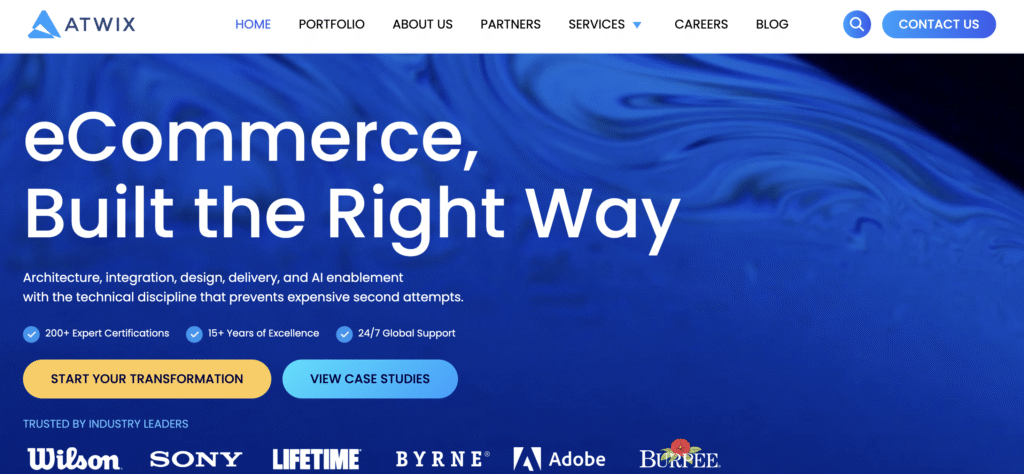
It’s an Adobe Commerce agency with Magento development services. Its Magento background includes contributions to the Magento ecosystem and work with enterprise integrations.
These are pros of Atwix:
- Adobe Commerce expertise.
- ERP integration experience.
- B2B Magento development.
Your project can benefit from Atwix when you need Magento combined with ERP or other enterprise systems.
Soloway
Soloway.tech is a software development company with Magento and many other services for ecommerce businesses. Its work includes Magento development, migrations, custom integrations, maintenance, etc.
Here’s a list of advantages of Soloway.tech:
- Magento development.
- Teams that focus only on the client’s task.
- Migration services.
- Custom integrations.
- E-commerce maintenance.
- Experience and a wide skill range of teams.
Soloway.tech suits businesses that need a Magento development team for a defined project or long-term technical work. It provides ongoing support for projects.
Red Jumpers
It’s a technology company with Magento and ecommerce development services. It has teams with extensive experience and a wide service range.
Here’s a list explains the pros of Red Jumpers:
- Magento development.
- Ecommerce development.
- PWA development.
- IT staff augmentation.
Red Jumpers can fit businesses that need Magento developers plus wider software expertise.
Rave Digital
The agency works with Magento and Adobe Commerce for B2B and B2C stores. Here’s a list of advantages of Rave Digital:
- Magento extension development.
- B2B and B2C ecommerce work.
- Magento migration services.
- Adobe Commerce expertise.
Rave Digital can suit projects that need custom Magento functionality plus ongoing maintenance.
Elogic Commerce
The company handles Magento and Adobe Commerce projects for mid-market and enterprise businesses. Its services include B2B ecommerce, integrations, migrations, and more.
These are strong sides of Elogic Commerce:
- Enterprise Magento development.
- B2B ecommerce expertise.
- ERP, CRM, PIM, and OMS integrations.
- Hyvä development.
Elogic can be helpful if you have a store with several external systems and complex business rules. Ask for a technical plan that names every required integration and Magento component.
Brainvire Infotech
Brainvire Infotech is an Adobe Gold Partner with Magento development services for ecommerce businesses. These are benefits of Brainvire Infotech:
- Adobe Commerce expertise.
- Magento upgrade services.
- Hyvä development.
- Large technical team.
Brainvire is ideal for larger projects that need Magento combined with other enterprise systems.
Ziffity Solutions
Ziffity Solutions is an Adobe Gold Solution Partner with Adobe Commerce and Magento services. They provide services like Magento development, customization, migrations, integrations, and managed services for enterprise ecommerce.
These are pros of Ziffity Solutions:
- Adobe Commerce expertise.
- Magento migration services.
- Enterprise ecommerce work.
Ziffity can be great larger stores with complex Magento requirements and long-term maintenance needs.
Staylime
The company provides Magento development and related ecommerce services. Staylime includes Magento 2 migrations, custom development, extensions, themes, integrations, SEO, and maintenance.
Here’s a list of advantages of Staylime:
- Magento specialization.
- Extension development.
- Magento 2 migration.
- Custom integrations.
- Maintenance services.
Staylime is like a Magento-focused team rather than a general software agency.
How We Ranked Magento Development Companies
We assess engineering capability, portfolios, client feedback, pricing, communication, time zone coverage, and post-launch support. These factors help you compare agencies:
- Engineering expertise and technical skills.
- Delivery track record and portfolio strength.
- Client reviews and global reputation.
- Cost efficiency and pricing models.
- Communication, time zone coverage, and support.
Check how each company handles Magento upgrades, custom modules, integrations, performance issues, and long-term maintenance before you sign a contract.
Engineering Expertise and Technical Skills
You should also check whether developers have experience with Adobe Commerce if your store uses enterprise features.
A capable Magento team should know:
- Magento 2 architecture.
- PHP.
- MySQL.
- APIs.
- GraphQL.
- JavaScript.
- Theme development.
- Extension development.
- Cloud infrastructure.
Ask each company how it handles Magento upgrades, custom extensions, third-party integrations, cache configuration, database issues, and checkout changes. Request examples that match your store’s architecture rather than generic Magento projects. You should also ask who will write the code, who will review it, and what documentation you’ll receive.
Delivery Track Record and Portfolio Strength
A portfolio should show projects with business requirements that resemble yours. Look for Magento stores with similar catalog size, checkout requirements, integrations, customer accounts, and regional needs.
Check project scope and ask what the company changed, which systems it integrated, what problems appeared during development, and how the team solved them.
Client Reviews and Global Reputation
Reviews can reveal how a company handles deadlines, communication, scope changes, defects, and post-launch requests. Give more weight to detailed reviews that describe the project, budget range, technology, and results.
Check several sources rather than relying on testimonials published by the company itself. You should also inspect review dates because old feedback may not reflect the current team.
Cost Efficiency and Pricing Models
Magento development costs vary based on project scope, developer location, seniority, integration work, and maintenance needs. Ask for a breakdown of development, project management, quality assurance, infrastructure, and maintenance costs.
Communication, Time Zone Coverage, and Support
Communication matters most when your store has production issues or a deadline for a major release. Check the team’s working hours, response times, communication channels, escalation process, and support schedule.
Ask whether you will have a named project manager and which developers will handle your store. You should also confirm how the company handles urgent defects, Magento security updates, backups, server incidents, and post-launch maintenance.
How to Choose the Right Magento Development Companies – Expert Advice

You can find an ideal company that fits your store when you assess its services against your actual business requirements. Start with your project scope, then check skills and experience with Magento, communication, future capacity, and long-term service terms.
Define Your Project Scope and Business Goals
Your project scope should state the Magento version, store type, catalog size, sales regions, integrations, checkout requirements, and planned changes. State your business targets, such as a migration, a new B2B store, faster page response, ERP integration, or custom Magento functionality.
Evaluate Technical Stack and Engineering Talent
Check the company’s Magento certifications, Adobe Commerce knowledge, PHP skills, API work, database knowledge, frontend development, cloud services, and extension development. Ask which developers will work on your store and request examples of Magento projects that use similar technologies.
You should also ask how the company handles Magento upgrades, custom modules, third-party integrations, code reviews, performance issues, and security updates. Don’t rely on a sales representative’s description of developer skills; ask for concrete project examples and the names or roles of the people assigned to the work.
Check Communication Processes and Time Zone Fit
Your project needs a defined communication process from the first week. Ask how often you will receive status reports, which system the team uses for tasks, who handles urgent issues, and how you can contact the project manager or lead developer.
Time zone coverage matters when your store has strict release dates or urgent production issues. Check the team’s normal work hours and ask whether developers can respond during your business hours. You should also confirm response times for critical defects, standard requests, and planned maintenance.
Consider Scalability and Long-Term Partnership Potential
Magento stores often need new integrations, version upgrades, performance work, feature changes, and maintenance after the initial project. Check whether the company has enough Magento developers for future work and whether it has experience with stores that grew in catalog size, order volume, or regional coverage.
Ask about maintenance contracts, developer availability, hourly rates, response times, and knowledge transfer. Your contract should state who owns the source code, documentation, credentials, and custom modules. You should also check the process for a future developer to take over the store if your business needs change.